
For my whole life I have taken inspiration from the sound of the human voice. I sang in church choir, school choir and in plays. Spoken word and theatre provided a rich sonic diet and livelihood for many years but choir-leading is now both my passion and my career. I gather singers together to weave harmonies and dissonances that move the soul and vibrate the cells of our bodies.
A’Capella polyphonic singing has such a profound effect on both the creators and the receivers of the sound; it’s unlike anything else. Music is an invisible, ephemeral art form but it can change everything.
As a result, all cultures make community and beauty through song. I honour these differing polyphonies by teaching songs from other countries often in languages not my own.
We immerse audiences in ‘song baths’ suggesting that they close their eyes and feel the music in their bodies. This kind of performance is about making an immersive, resonant soundscape. Rather like bathing in pure human sound with loving, present, un-amplified voices. I always include a trio at some point in each set, so that the audience gets a surprise when the sound shrinks and expands again.
Choir Leader
I have been teaching singing for 25 years and currently run five different choirs each week. I started my main group, Acapellies, ten years ago to build a choir that was creative and willing to perform. My leadership is rooted in inclusivity; I do not hold auditions and I ensure my groups are accessible by keeping fees low or negotiable. Whether it is the Spring Hill Singers, which I have led for over two decades, or the newer Acapeeps, I strive to create bonded, multigenerational communities. We are very much a charity fundraising choir, raising significant money for organisations in Ukraine and Palestine. My role is to foster a sense of togetherness where people sing in a circle, look at each other, and regulate the anxieties of modern life. I learned commitment early as a child in church choirs, and I carry that faith into my work today, trusting that every song we explore can be gorgeous. Ultimately, I see these groups as a direct way to balance the “madness” of the world through generous song.
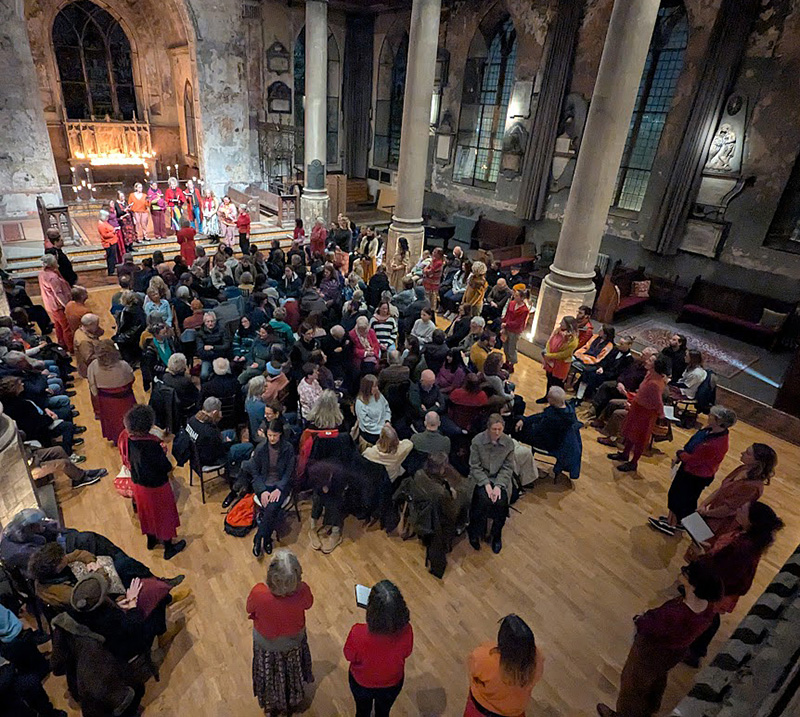
Having a greater connection with the audience is where my passion lies. I want our performances to be interactive, inclusive and community-building. Following Songs of Fortitude (see performances), and until now, Acapellies offer ‘live surround sound’. The singers surround the listeners and connect with them and with each other. We mix up all the parts and harmonies and also we walk around the space and gather in different areas to change-up the sound. The listeners are invited to close their eyes and open their hearts.
Song Forager
I call myself a “song forager” because I am constantly gathering sounds like someone stuffing a basket with treasures. This process involves hunting for choral music in secondhand shops or literally asking trees and rivers to tell me a song. I find deep inspiration in literature and nature; for example, a song once emerged directly from my reading of Dorothy Wordsworth’s journals. My university studies of the Romantics (“Romantic with a capital R”) gave me an impulse to express poetry through music.
I am particularly drawn to the dissonant harmonies of Eastern Europe, and I believe music is a “great big connector” that effortlessly crosses boundaries. While some worry about cultural appropriation I feel that honouring these traditions and singing them in their original style is a form of conservation. Whether I am working with an ancient Icelandic saga or a Latvian village song, I aim to capture the essence and ritual of the tradition. Having a choir like Acapellies allows me to forage these global sounds and bring them into an immediate, living performance.
Performances
link to … recent performance projects